دوماهنامه

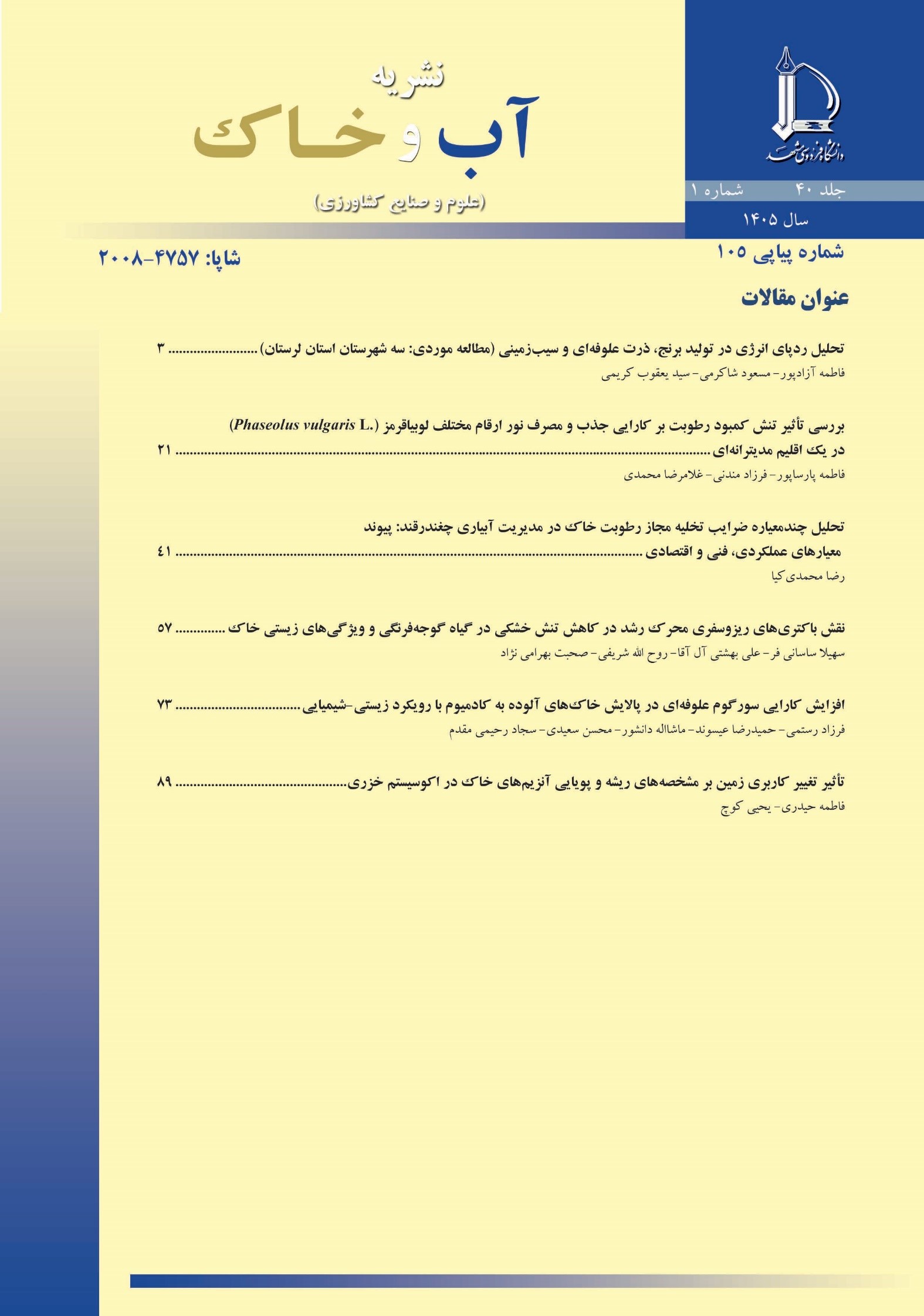
نقش باکتری‌های ریزوسفری محرک رشد در کاهش تنش خشکی در گیاه گوجه‌فرنگی و ویژگی‌های زیستی خاک

نوع مقاله : مقالات پژوهشی

نویسندگان

1 گروه علوم و مهندسی خاک، دانشگاه رازی، کرمانشاه، ایران

2 استادیار گروه گیاه پزشکی، پردیس کشاورزی و منابع طبیعی، دانشگاه رازی کرمانشاه

3 گروه مهندسی تولید و ژنتیک گیاهی، دانشگاه رازی، کرمانشاه، ایران

چکیده
تنش خشکی از جمله تنش‌های فیزیکی است که به‌عنوان مهم‌ترین عامل محدودکننده رشد و تولید گیاهان زراعی در اکثر نقاط جهان شناخته شده است. تنش خشکی نه تنها ویژگی‌های فیزیکی و شیمیایی خاک و رشد گیاه را دگرگون می‌کند، بلکه بر ویژگی‌های زیستی خاک نیز تأثیر می‌گذارد. با توجه به این‌که بیشتر مناطق ایران در اقلیم خشک و نیمه‌خشک قرار گرفته و با در نظر گرفتن مزیت‌های باکتری‌های محرک رشد در کاهش تنش‌ها در مقایسه با سایر روش‌ها، در این پژوهش تأثیر باکتری‌های ریزوسفری محرک رشد در کاهش تنش خشکی در گیاه گوجه‌فرنگی و ویژگی‌های زیستی خاک بررسی شد. آزمایشی گلخانه‌ای به‌صورت فاکتوریل و در قالب طرح بلوک­های کامل تصادفی با چهار تکرار انجام شد. تیمارهای آزمایشی شامل چهار سطح تنش خشکی شامل 40، 60، 80 و 100 درصد رطوبت مزرعه و پنج سویه باکتری شامل B19 (Lysinibacillus sphaericus)، B60 (Bacillus sp.)، B103 (Lysibacillus sp.)، B124 (Achromobacter sp.) و GB03 (Bacillus subtilis) بودند. همچنین یک تیمار شاهد (بدون باکتری و بدون تنش خشکی) نیز در نظر گرفته شد. به‌منظور اعمال تیمارها، گلدان­های 4 کیلوگرمی با استفاده از خاک زراعی عبور داده شده از الک 4 میلی‌متر آماده شدند. ریشه‌های نشای گوجه­فرنگی قبل از انتقال به گلدان­های اصلی با توجه به تیمار مربوطه با باکتری­های ریزوسفری محرک رشد به‌مدت 20 دقیقه آغشته و سپس نشاء­ها به گلدان اصلی انتقال داده شدند. به‌منظور اطمینان از استقرار گیاه، همه گلدان­ها به‌مدت 3 الی 4 هفته آبیاری شدند. در ادامه دوره کشت، با اندازه‌گیری رطوبت خاک به روش وزنی، تنش خشکی مورد نظر اعمال شد. ویژگی‌های تعداد گل، وزن تر بخش هوایی و ریشه، مقاومت روزنه­ای، وزن تر میوه و مقدار پرولین آزاد برگ اندازه­گیری شدند. همچنین ویژگی‌های زیستی خاک شامل معدنی شدن کربن آلی، کربن زیست‌توده میکروبی، تنفس برانگیخته و کسر متابولیک پس از برداشت گیاهان در خاک تعیین شدند. نتایج این مطالعه نشان داد که هر پنج سویه باکتری استفاده شده، باعث افزایش معنادار وزن تر اندام هوایی، تعداد گل و وزن میوه شدند. مقدار پرولین آزاد در برگ افزایش معناداری نسبت به تیمار شاهد (عدم تلقیح) داشت. نتایج نشان داد، مقدار مقاومت روزنه­ای کاهشی معنادار، نسبت به تیمار شاهد (عدم تلقیح) داشت. همچنین سویه­های استفاده شده باعث بهبود کیفیت ویژگی‌های بیولوژیک خاک شدند، به‌طوری‌که تنفس پایه، تنفس برانگیخته و کربن زیست‌توده میکروبی افزایشی معنی‌داری داشتند، اما کسر متابولیک کاهشی معنی‌داری نسبت به تیمار شاهد (عدم تلقیح) نشان داد. از بین پنج سویه به کار گرفته شده، سه سویه B19، B60 و B103 بیشترین تأثیر را در کاهش اثرات تنش خشکی نشان دادند. شرایط تنشی مختلف از جمله تنش رطوبتی حاکم بر کشاورزی ایران، موجب کاهش رشد و عملکرد محصولات کشاورزی می‌شود، بنابراین استفاده از مایه تلقیح حاوی ریز جانداران از جمله باکتری­های ریزوسفری محرک رشد که فعالیت آن‌ها در بهبود شرایط تنش به اثبات رسیده، دارای اهمیت فراوان است.

کلیدواژه‌ها

موضوعات

عنوان مقاله English

The Role of Plant Growth-Promoting Rhizobacteria in Reducing Drought Stress in Tomato Plants and Soil Biological Characteristics

نویسندگان English

S. Sasanifar 1
A. Beheshti Ale Agha 1
R. Sharifi 2
S. Bahraminejad 3
1 MSc in Soil Biology, Department of Soil Science, Razi University, Kermanshah, Iran
2 Assistant Professor of Department of Plant Protection, College of Agriculture and Natural Resources, Razi University of Kermanshah, Iran.
3 Professor, Department of Plant Production Engineering and Genetics, Razi University, Kermanshah, Iran.
چکیده English

Introduction
Background and objectives: Drought stress is one of the most significant abiotic stressors, recognized as a major constraint on agricultural plant growth and productivity worldwide. It adversely affects soil physicochemical properties and plant physiological processes, altering soil microbial dynamics. Drought stress reduces crop yields and degrades soil health in arid and semi-arid regions, where water scarcity is a critical challenge. Plant growth-promoting rhizobacteria (PGPR) have emerged as a sustainable and eco-friendly strategy to enhance plant resilience against abiotic stresses, including drought. These beneficial microorganisms improve nutrient uptake, stimulate phytohormone production, and enhance stress tolerance mechanisms in plants, thereby mitigating the negative impacts of water deficit. Considering that most of the regions of Iran are located in arid and semi-arid climates and taking into account the advantages of plant growth-promoting rhizobacteria in reducing stress compared to other physical and chemical methods, this research investigated the effect of plant growth-promoting rhizobacteria on reducing drought stress in the tomato plant and biological characteristics of the soil.
 .
 
Materials and Methods
A greenhouse experiment was conducted in a randomized complete block design (RCBD) with four replications. Experimental treatments included four levels of drought stress (40, 60, 80, and 100% of FC) and five bacterial strains: B19 (Lysinibacillus sphaericus), B60 (Bacillus sp.), B103 (Lysibacillus sp.), B124 (Achromobacter sp.), and GB03 (Bacillus subtilis). A control treatment (without bacteria and drought stress) was also considered. To apply the treatments, 4 kg pots were prepared using soil passed through a 4 mm sieve. Nutrient Broth (NB) medium was used for cultivation to enhance the bacterial population. The bacteria were grown under controlled conditions at 30°C with continuous shaking at 120 rpm for 36 hours to ensure optimal growth. After incubation, a bacterial suspension with a concentration of 109 CFU/mL was prepared in sterile distilled water. Tomato seedlings' roots were then immersed in this suspension for 20 minutes to ensure proper colonization before being transplanted into the potted soil. A control treatment (non-inoculated seedlings) was also included in the experiment for comparative analysis. To ensure the establishment of the plants, all the pots were irrigated for 3 to 4 weeks. The desired drought stress was applied during the cultivation period by measuring soil moisture using the gravimetric method. In this method, the weight of the pots was measured every day, and irrigation was performed immediately after the soil moisture decreased. This method of applying treatments continued daily for three months. The greenhouse temperature was 25°C and the lighting period was 12 hours. The characteristics of the number of flowers, fresh weight of the aerial part and roots, stomatal resistance, fresh weight of the fruit, and the amount of the free proline content of the leaves were measured. In addition, soil biological characteristics, including organic carbon mineralization, microbial biomass carbon, substrate-induced respiration (SIR), and metabolic quotient (qCO2) after plant harvesting, were determined in the soil. Before performing the analysis of variance (ANOVA), the normality of the data was tested. In this study, Duncan's 5% probability level test was used for mean comparisons, Excel software was used for graphing, and SAS 9.4 was employed for data analysis.
 
Results
The results of this study showed that all five bacterial strains used caused significant increases in the fresh weight of the shoot, the number of flowers, and the fruit weight. The amount of free proline in the leaves increased significantly compared to the control treatment (no inoculation). The results showed that the value of stomatal resistance had a significant decrease compared to the control treatment (no inoculation). Also, the used strains improved the quality of soil biological characteristics, so that basal respiration, substrate-induced respiration (SIR), and microbial biomass carbon had a significant increase, but the metabolic quotient (qCO2) showed a significant decrease compared to the control treatment (no inoculation). Among the five strains used, three strains, B19, B60, and B103 showed the greatest effect in reducing the effects of drought stress.
 
Conclusion
Various stressful conditions, including the moisture stress prevailing in Iran's agriculture, cause a decrease in the growth and yield of agricultural products; therefore, the use of inoculants containing microorganisms, including plant growth-promoting rhizobacteria, whose activity has been proven to improve stress conditions, is essential.

کلیدواژه‌ها English

Metabolic quotient
Microbial biomass carbon
Microbial respiration
Proline
Yield

Authors retain the copyright. This is an open access article distributed under Creative Commons Attribution 4.0 International License (CC BY 4.0).

  1. Abbasi, S., Sadeghi, A., & Safaie, N. (2020). Streptomyces alleviate drought stress in tomato plants and modulate the expression of transcription factors ERF1 and WRKY70 genes. Scientia Horticulturae, 265, 109206. https://doi.org/10.1016/j.scienta.2020.109206
  2. Abdelaal, K., Elafry, M., Abdel-Latif, I., Elshamy, R., Hassan, M., & Hafez, Y. (2021). Pivotal role of yeast and ascorbic acid in improvement the morpho-physiological and yield characters of two wheat cultivars under water deficit stress in calcareous soil. Notulae Botanicae Horti Agrobotanici Cluj-Napoca, 50(2), 12710. https://doi.org/10.15835/nbha50212710
  3. Alef, K., & Nannipieri, P. (1995). Methods in applied soil microbiology and biochemistry. Academic Press.
  4. Amani-Mehr, M. (2016). Biological control of tomato damping-off caused by Pythium aphanidermatum with rhizobacteria isolated from tomato rhizosphere Razi University].
  5. Amiri, S., Nosrati, I., Mohammadi, G.R., Kahrizi, D., & Sharifi, R. (2018). Rye (Secale cereale ) and plant probiotics interaction on control of branched broomrape (Phelipanche ramose) on tomato (Solanum lycopersicum) Sivand and Super strain B cultivars. Journal of Agricultural Science and Sustainable Production, 28(1), 139-149. http://sustainagriculture.tabrizu.ac.ir/article_7348_12fd57bc1bcd0f0060361b4a84a36448.pdf
  6. Anderson, J.P. (1982). Soil respiration. In A. L. Page, R. H. Miller, & D. R. Keeney (Eds.), Methods of soil analysis. Part 2. Chemical and microbiological properties (pp. 831-871). American Society of Agronomy and Soil Science Society of America. https://doi.org/10.2134/agronmonogr9.2.2ed.c41
  7. Anderson, T.H., & Domsch, K.H. (1993). The metabolic quotient for CO2 (qCO2) as a specific activity parameter to assess the effects of environmental conditions, such as pH, on the microbial biomass of forest soils. Soil Biology and Biochemistry, 25(3), 393-395. https://doi.org/10.1016/0038-0717(93)90140-7
  8. Anjum, S.A., Farooq, M., Xie, X.-y., Liu, X.-j., & Ijaz, M.F. (2012). Antioxidant defense system and proline accumulation enables hot pepper to perform better under drought. Scientia Horticulturae, 140, 66-73. https://doi.org/10.1016/j.scienta.2012.03.028
  9. Arunachalam, A., & Arunachalam, K. (2000). Influence of gap size and soil properties on microbial biomass in a subtropical humid forest of north-east India. Plant and Soil, 223(1-2), 187-195. https://doi.org/10.1023/A: 1004828221756
  10. Banik, P., Zeng, W., Tai, H., Bizimungu, B., & Tanino, K. (2016). Effects of drought acclimation on drought stress resistance in potato (Solanum tuberosum) genotypes. Environmental and Experimental Botany, 126, 76-89. https://doi.org/10.1016/j.envexpbot.2016.01.008
  11. Bates, L.S., Waldren, R., & Teare, I. (1973). Rapid determination of free proline for water-stress studies. Plant and Soil, 39, 205-207. https://doi.org/10.1007/BF00018060
  12. Boyerahmadi, M., Raiesi, F., & Mohammadi, J. (2010). Influence of different salinity levels on some microbial indices in the presence and absence of plant’s living roots [Research]. Journal of Water and Soil Science, 14(51), 103-115. http://jstnar.iut.ac.ir/article-1-1211-fa.html
  13. Branson, F., Miller, R.F., & McQueen, I. (1967). Geographic distribution and factors affecting the distribution of salt desert shrubs in the United States. Journal of Range Management, 287-296. https://doi.org/10.2307/3895974
  14. Dane, J.H., & Topp, C.G. (Eds.). (2020). Methods of soil analysis, Part 4: Physical methods. John Wiley & Sons.
  15. Dey, R., Pal, K., Bhatt, D., & Chauhan, S. (2004). Growth promotion and yield enhancement of peanut (Arachis hypogaea) by application of plant growth-promoting rhizobacteria. Microbiological Research, 159(4), 371-394. https://doi.org/10.1016/j.micres.2004.08.004
  16. Egea, I., Estrada, Y., Flores, F.B., & Bolarín, M.C. (2022). Improving production and fruit quality of tomato under abiotic stress: Genes for the future of tomato breeding for a sustainable agriculture. Environmental and Experimental Botany, 204, 105086. https://doi.org/10.1016/j.envexpbot.2022.105086
  17. Eziz, A., Yan, Z., Tian, D., Han, W., Tang, Z., & Fang, J. (2017). Drought effect on plant biomass allocation: A meta‐analysis. Ecology and Evolution, 7(24), 11002-11010. https://doi.org/10.1002/ece3.3630
  18. Farooq, M., Hussain, M., Wahid, A., & Siddique, K. (2012). Drought stress in plants: an overview. In Plant responses to drought stress: From morphological to molecular features (pp. 1-33). https://doi.org/10.1007/978-3-642-32653-0_1
  19. Galleguillos, C., Aguirre, C., Barea, J.M., & Azcon, R. (2000). Growth promoting effect of two Sinorhizobium meliloti strains (a wild type and its genetically modified derivative) on a non-legume plant species in specific interaction with two arbuscular mycorrhizal fungi. Plant Science, 159(1), 57-63. https://doi.org/10.1016/S0168-9452(00)00321-6
  20. García-Fraile, P., Menéndez, E., & Rivas, R. (2015). Role of bacterial biofertilizers in agriculture and forestry. Aims Bioengineering, 2(3), 183-205. https://doi.org/10.3934/bioeng.2015.3.183
  21. Gollar, A.M., Raiese, F., & Nadian, H. (2008). Salinity and phosphorus interactions on growth, yield and nutrient uptake by berseem clover (Trifolium alexandrinum ). Journal of Agronomic Researchs of Iran, 22(2), 217-223.
  22. Gowtham, H., Singh, B., Murali, M., Shilpa, N., Prasad, M., Aiyaz, M., Amruthesh, K., & Niranjana, S. (2020). Induction of drought tolerance in tomato upon the application of ACC deaminase producing plant growth promoting rhizobacterium Bacillus subtilis Rhizo SF 48. Microbiological Research, 234, 126422. https://doi.org/10.1016/ j.micres.2020.126422
  23. Han, Q.Q., Lu, X.P., Bai, J.P., Qiao, Y., Pare, P.W., Wang, S.M., Zhang, J.L., Wu, Y.N., Pang, X.P., Xu, W.B., & Wang, Z.L. (2014). Beneficial soil bacterium Bacillus subtilis (GB03) augments salt tolerance of white clover. Front Plant Science, 5, 525. https://doi.org/10.3389/fpls.2014.00525
  24. Horwath, W.R., & Paul, E.A. (1994). Microbial biomass. In D. R. Buxton (Ed.), Methods of soil analysis. Part 2: Microbiological and biochemical properties (pp. 753-773). SSSA Book Series. https://doi.org/10.2136/ sssabookser5.2.c36
  25. Huang, X.F., Zhou, D., Guo, J., Manter, D., Reardon, K., & Vivanco, J. (2015). Bacillus from rainforest soil promote plant growth under limited nitrogen conditions. Journal of Applied Microbiology, 118(3), 672-684. https://doi.org/10.1111/jam.12720
  26. Jabbari, F., & Khaleghnezhad, V. (2014). Consideration of some biofertilizers effect on water relations and gas exchange of chickpea (Cicer arietinum) under irrigated and rainfed conditions. Iranian Journal of Field Crop Science, 45(1), 53-64. https://doi.org/10.22059/ijfcs.2014.51026
  27. Jafari, S., Chorom, M., Enayatizamir, N., & Motamedi, H. (2013). Evaluating the effects of Bacillus subtilis and Corynebacterium glutamicum on soil microbial indexes in different levels of salinity. Journal of Agricultural Engineering, 35(2), 55-70. http://agrieng.scu.ac.ir/article_10008_479a5e5bdd9d9962623c76e0805f1152.pdf
  28. Kasim, W.A., Osman, M.E., Omar, M.N., Abd El-Daim, I.A., Bejai, S., & Meijer, J. (2013). Control of drought stress in wheat using plant-growth-promoting bacteria. Journal of Plant Growth Regulation, 32, 122-130. https://doi.org/10.1007/s00344-012-9283-7
  29. Khan, N., & Bano, A. (2019). Exopolysaccharide producing rhizobacteria and their impact on growth and drought tolerance of wheat grown under rainfed conditions. PLoS One, 14(9), e0222302. https://doi.org/10.1371/ journal.pone.0222302
  30. Khan, S.H., Arsalan Khan, A.K., Uzma Litaf, U.L., Shah, A.S., Khan, M.A., Muhammad Bilal, M.B., & Ali, M.U. (2015). Effect of drought stress on tomato cv. Bombino. Journal of Food Processing and Technology, 6(7). https://doi.org/10.4172/2157-7110.1000465
  31. Kou, X., Han, W., & Kang, J. (2022). Responses of root system architecture to water stress at multiple levels: A meta-analysis of trials under controlled conditions. Front Plant Science, 13, 1085409. https://doi.org/10.3389/ 2022.1085409
  32. Kussainova, M., & Kızılkaya, R. (2021). The effect of inoculation with amycolatopsis strains on yield and nutrient content of wheat (Triticum Aestivum) and soil microbiological properties. Research Square. https://doi.org/ 10.21203/rs.3.rs-814356/v1
  33. Lum, M., Hanafi, M., Rafii, Y., & Akmar, A. (2014). Effect of drought stress on growth, proline and antioxidant enzyme activities of upland rice. The Journal of Animal and Plant Sciences, 24(5), 1487-1493.
  34. Mafakheri, A., Siosemardeh, A., Bahramnejad, B., Struik, P., & Sohrabi, Y. (2010). Effect of drought stress on yield, proline and chlorophyll contents in three chickpea cultivars. Australian Journal of Crop Science, 4(8), 580-585.
  35. Manafi, H., Aliasgharzad, N., Neyshabouri, M., & Rejali, F. (2012). Tolerance to water deficit stress in tomato inoculated with Arbuscular Mycorrhizal fungi. Water and Soil Science, 22(2), 1-17.
  36. Martinez-Sergio, A., & Jenny, D. (2018). Lysinibacillus sphaericus plant growth promoter bacteria and lead phytoremediation enhancer with Canavalia ensiformis. Environmental Progress and Sustainable Energy, 37(1), 276-282. https://doi.org/10.1002/ep.12668
  37. Meenakshi, Annapurna, K., Govindasamy, V., Ajit, V., & Choudhary, D. (2019). Mitigation of drought stress in wheat crop by drought tolerant endophytic bacterial isolates. Vegetos, 32(4), 486-493. https://doi.org/10.1007/ s42535-019-00060-1
  38. Mierzwa-Hersztek, M., Klimkowicz-Pawlas, A., & Gondek, K. (2018). Influence of poultry litter and poultry litter biochar on soil microbial respiration and nitrifying bacteria activity. Waste and Biomass Valorization, 9, 379-389. https://doi.org/10.1007/s12649-017-0013-z
  39. Mohammadi, M., Malakouti, M., Khavazi, K., Rejali, F., & Davoodi, M. (2015). The effect of bio-fertilizer and chemical fertilizers (phosphate and zinc) on yield and yield components of two cultivars of bean (Phaseolus vulgaris). Journal of Water and Soil, 29(1), 176-187. https://doi.org/10.22067/jsw.v0i0.28483
  40. Mohammadian, R., Khoyi, F.R., Rahimian, H., Moghadam, M., Ghassemi-Golezani, K., & Sadeghian, S.Y. (2001). The effects of early season drought on stomatal conductance, leaf-air temperature difference and proline accumulation in sugar beet genotypes. Journal of Agricultural Science and Technology, 3(3), 181-192.
  41. Monteith, J., Szeicz, G., & Waggoner, P. (1965). The measurement and control of stomatal resistance in the field. Journal of Applied Ecology, 2(2), 345-355. https://doi.org/10.2307/2401484
  42. Nahidan, S., & Nourbakhsh, F. (2009). The effect of organic carbon managment on some biological factors of soil. 15th Soil Science Congress,
  43. Nair, A.S., Abraham, T., & Jaya, D. (2008). Studies on the changes in lipid peroxidation and antioxidants in drought stress induced cowpea (Vigna unguiculata ) varieties. Journal of Environmental Biology, 29(5), 689-691.
  44. Najafvand, S., Najafvand, S., Khaleghi, S.S., & Alemzadeh, N. (2007). The effect of biological fertilizer Nitroxin on tomato seedling growth factors. 5th Horticulture Congress Shiraz, Iran.
  45. Narula, N., Kumar, V., Behl, R.K., Deubel, A., Gransee, A., & Merbach, W. (2000). Effect of P‐solubilizing Azotobacter chroococcum on N, P, K uptake in P‐responsive wheat genotypes grown under greenhouse conditions. Journal of Plant Nutrition and Soil Science, 163(4), 393-398. https://doi.org/10.1002/1522-2624(200008) 163:4%3C393::AID-JPLN393%3E3.0.CO;2-W
  46. Naureen, Z., Ur Rehman, N., Hussain, H., Hussain, J., Gilani, S., K. Al Housni, S., Mabood, F., Khan, A., Farooq, S., Abbas, G., & Al-Harrasi, A. (2017). Exploring the potentials of Lysinibacillus sphaericus ZA9 for plant growth promotion and biocontrol activities against phytopathogenic fungi. Frontiers in Microbiology, 8. https://doi.org/10.3389/fmicb.2017.01477
  47. Naveed, M., Hussain, M.B., Zahir, Z.A., Mitter, B., & Sessitsch, A. (2014). Drought stress amelioration in wheat through inoculation with Burkholderia phytofirmans strain PsJN. Plant Growth Regulation, 73, 121-131. https://doi.org/10.1007/s10725-013-9874-8
  48. Niu, X., Song, L., Xiao, Y., & Ge, W. (2018). Drought-tolerant plant growth-promoting rhizobacteria associated with foxtail millet in a semi-arid agroecosystem and their potential in alleviating drought stress. Frontiers in Microbiology, 8, 2580. https://doi.org/10.3389/fmicb.2017.02580
  49. Norjo, A., Zomorodi, S., & Amami, A. (2001). The effect of diffrent irrigation level on tomato. First National Confrence on Mitigation of Water Crises, Zabol, Iran.
  50. Nouri, M., & Homaee, M. (2020). Drought trend, frequency and extremity across a wide range of climates over Iran. Meteorological Applications, 27(2), e1899. https://doi.org/10.1002/met.1899
  51. Rezaie, R., & Raiesi, F. (2016). Effect of superabsorbent polymers on soil microbial respiration and biomass under drought stress condition. Journal of Soil Biology, 3(2), 151-162. https://doi.org/10.22092/sbj.2016.105966
  52. Rostamikia, Y., Tabari Kouchaksaraei, M., Asgharzadeh, A., & Rahmani, A. (2016). The effect of plant growth-promoting Rhizobacteria on growth and physiological characteristics of Corylus avellana Ecopersia, 4(3), 1471-1479. https://doi.org/10.18869/modares.ecopersia.4.3.1471
  53. Rui, Y., Murphy, D.V., Wang, X., & Hoyle, F.C. (2016). Microbial respiration, but not biomass, responded linearly to increasing light fraction organic matter input: Consequences for carbon sequestration. Scientific Reports, 6(1), 35496. https://doi.org/10.1038/srep35496
  54. Saharan, B., & Nehra, V. (2011). Plant growth promoting rhizobacteria: a critical review. Life Science and Medical Research, 21(1), 1-30.
  55. Sánchez-Rodríguez, E.N., Nava-Salazar, S., Morán, C., Romero-Arauz, J.F., & Cerbón-Cervantes, M.A. (2010). Estado actual de la preeclampsia en México: de lo epidemiológico a sus mecanismos moleculares. Revista de Investigación Clínica, 62(3), 252-260.
  56. Sarfraz, R., Hussain, A., Sabir, A., Ben Fekih, I., Ditta, A., & Xing, S. (2019). Role of biochar and plant growth promoting rhizobacteria to enhance soil carbon sequestration-A review. Environmental Monitoring and Assessment, 191(251), 1-13. https://doi.org/10.1007/s10661-019-7400-9
  57. Sarma, R.K., & Saikia, R. (2014). Alleviation of drought stress in mung bean by strain Pseudomonas aeruginosa Plant and Soil, 377, 111-126. https://doi.org/10.1007/s11104-013-1981-9
  58. Siddiqui, M.H., Al-Khaishany, M.Y., Al-Qutami, M.A., Al-Whaibi, M.H., Grover, A., Ali, H.M., Al-Wahibi, M.S., & Bukhari, N.A. (2015). Response of different genotypes of faba bean plant to drought stress. International Journal of Molecular Sciences, 16(5), 10214-10227. https://doi.org/10.3390/ijms160510214
  59. Singh, R.P., & Jha, P.N. (2017). The PGPR Stenotrophomonas maltophilia SBP-9 augments resistance against biotic and abiotic stress in wheat plants. Frontiers in Microbiology, 8, 275381. https://doi.org/10.3389/ fmicb.2017.01945
  60. Suman, A., Lal, M., Singh, A., & Gaur, A. (2006). Microbial biomass turnover in Indian subtropical soils under different sugarcane intercropping systems. Agronomy Journal, 98(3), 698-704. https://doi.org/10.2134/ agronj2005.0173
  61. Tourajzadeh, O., Piri, H., Naserin, A., & Mahdi Cahri, M. (2024). Effect of nano biochar addition and deficit irrigation on growth, physiology and water productivity of quinoa plants under salinity conditions. Environmental and Experimental Botany, 217, 105564. https://doi.org/10.1016/j.envexpbot.2023.105564
  62. Trovato, M., Forlani, G., Signorelli, S., & Funck, D. (2019). Proline metabolism and its functions in development and stress tolerance. Osmoprotectant-mediated abiotic stress tolerance in plants: recent advances and future perspectives, 41-72. https://doi.org/10.1007/978-3-030-27423-8_2
  63. Vafadar, R., Ghavidel, A., Goli, E., & Soltani, A.A. (2017). The effect of Pseudomonas fluorescens and Pseudomonas putida on some soil biological properties and plant growth indices of wheat under salt stress. Journal of Agricultural Science and Sustainable Production, 27(4), 65-79.
  64. Vikram, A. (2007). Interaction Between Pseudomonas fluorescens FPD-15 and Bradyrhizobium in Peanut. Biotechnology, 6(2), 292-298. https://doi.org/10.3923/biotech.2007.292.298
  65. Wong, V.N., Dalal, R.C., & Greene, R.S. (2008). Salinity and sodicity effects on respiration and microbial biomass of soil. Biology and Fertility of Soils, 44(7), 943-953. https://doi.org/10.1007/s00374-008-0279-1
  66. Yadav, S., Modi, P., Dave, A., Vijapura, A., Patel, D., & Patel, M. (2020). Effect of abiotic stress on crops. In Sustainable Crop Production (pp. 352). https://doi.org/10.5772/intechopen.88434
  67. Zahir, Z.A., Arshad, M., & Frankenberger, W.T. (2004). Plant growth promoting rhizobacteria: applications and perspectives in agriculture. Advances in Agronomy, 81, 98-169. https://doi.org/10.1016/S0065-2113(03)81003-9
  68. Zeng, W.-Z., Xu, C., Wu, J.-W., Huang, J.-S., & Ma, T. (2013). Effect of salinity on soil respiration and nitrogen dynamics. Ecological Chemistry and Engineering S, 20(3), 519-530. https://doi.org/10.2478/eces-2013-0039
  69. Zhang, H., Kim, M.S., Sun, Y., Dowd, S.E., Shi, H., & Pare, P.W. (2008). Soil bacteria confer plant salt tolerance by tissue-specific regulation of the sodium transporter HKT1. Mol Plant Microbe Interact, 21(6), 737-744. https://doi.org/10.1094/mpmi-21-6-0737
ارسال نظر در مورد این مقاله
نام را وارد کنید.
نشانی پست الکترونیکی را به درستی وارد کنید.
وابستگی سازمانی را به درستی وارد کنید.
توضیحات را وارد کنید (حداقل 50 حرف)
CAPTCHA Image
شناسه امنیتی را به درستی وارد کنید.
دوره 40، شماره 1 - شماره پیاپی 105
فروردین و اردیبهشت 1405
صفحه 71-57

  • تاریخ دریافت 12 فروردین 1404
  • تاریخ بازنگری 18 خرداد 1405
  • تاریخ پذیرش 20 خرداد 1405
  • تاریخ اولین انتشار 20 خرداد 1405