فصلنامه

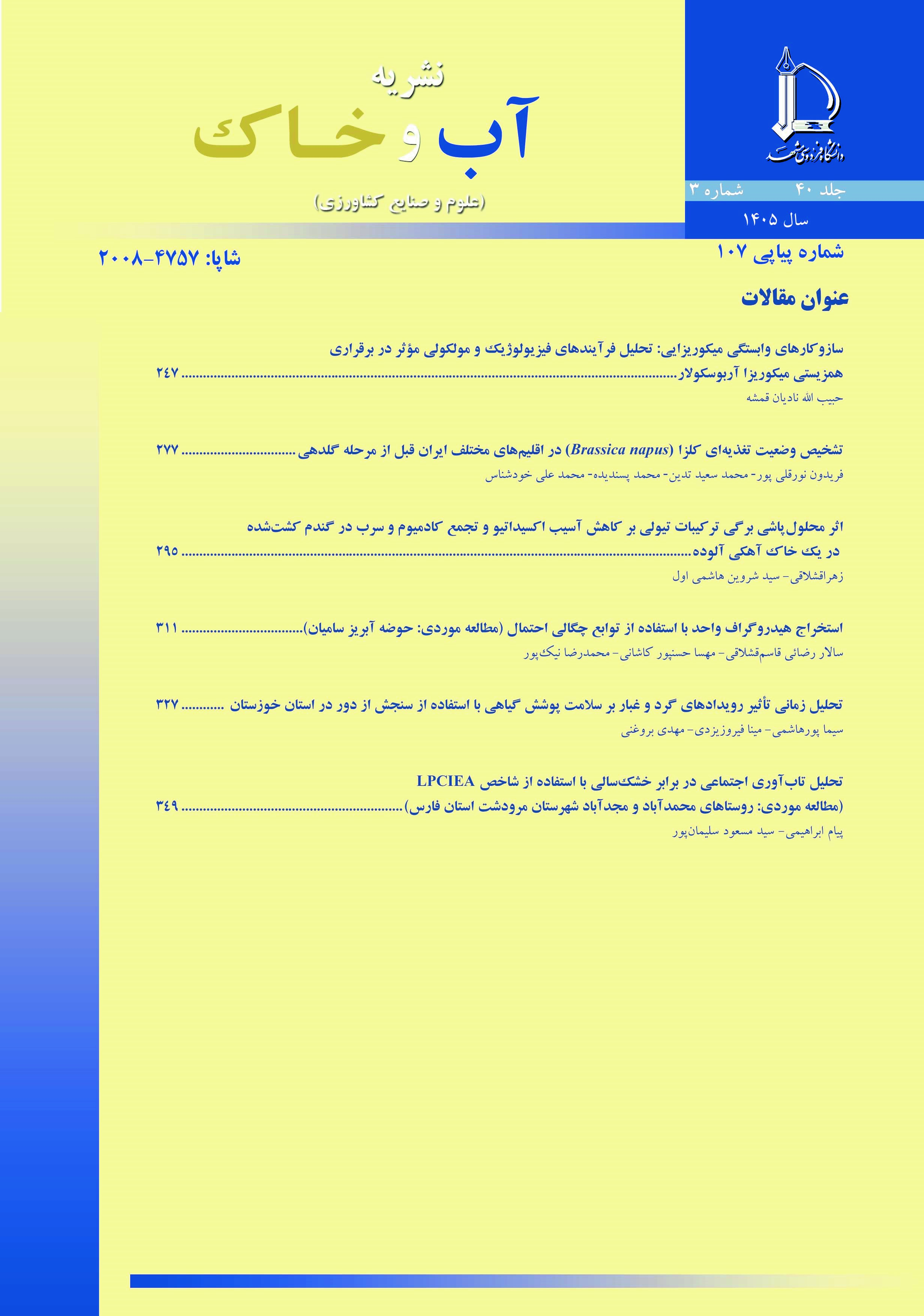
اثر محلول‌پاشی برگی ترکیبات تیولی بر کاهش آسیب اکسیداتیو و تجمع کادمیوم و سرب در گندم کشت‌شده در یک خاک آهکی آلوده

نوع مقاله : مقاله پژوهشی

نویسندگان

گروه مهندسی محیط‌زیست، دانشکده محیط‌زیست، دانشگاه تهران، تهران، ایران

چکیده
آلودگی هم‌زمان خاک‌های آهکی به کادمیم و سرب، با کاهش رشد، اختلال در فتوسنتز و تشدید آسیب اکسیداتیو[1]، تولید گندم را در مناطق خشک و نیمه‌خشک محدود می‌کند و از نظر زراعی و ایمنی غذایی اهمیت ویژه‌ای دارد. با این حال، کارایی کاربرد برگی توأم سیستئین و گلوتاتیون در تعدیل اختلال ردوکسی و کاهش تجمع فلزات در گندم کشت‌شده در خاک آهکی آلوده، به‌طور کامل روشن نشده است. این پژوهش با هدف ارزیابی اثر محلول‌پاشی برگی سیستئین و گلوتاتیون، به‌صورت انفرادی و توأم، بر کاهش تنش هم‌زمان کادمیم و سرب از طریق بهبود رشد، بازگردانی تعادل ردوکس گلوتاتیون و کاهش تجمع فلزات در گیاه گندم رقم فلات (Triticum aestivum L. cv. Falat) انجام شد. آزمایش به‌صورت گلدانی در گلخانه و در قالب طرح کاملاً تصادفی با 5 تیمار و 3 تکرار انجام شد. کادمیم و سرب به‌ترتیب با غلظت‌های ۱۵ و ۳۰۰ میلی‌گرم بر کیلوگرم خاک اعمال شدند و اثر تیمارها بر زیست‌توده، غلظت کلروفیل کل، شاخص‌های آسیب اکسیداتیو، مؤلفه‌های ردوکس گلوتاتیون و غلظت فلزات در ریشه و اندام هوایی گیاه گندم بررسی شد. نتایج نشان داد که تنش فلزات سنگین، زیست‌توده خشک اندام هوایی را از 50/12 به 10/7 گرم در گلدان و غلظت کلروفیل کل را از 10/2 به 10/1 میلی‌گرم بر گرم وزن‌تر کاهش داد، در حالی‌که شاخص استرس اکسیداتیو (OSI) از 05/0 به 37/0 افزایش یافت و نسبت گلوتاتیون احیا به اکسید شده (GSH/GSSG) از 61/5 به 07/1 کاهش پیدا کرد. اثر تیمارها بر زیست‌توده، غلظت کلروفیل، مالون‌دی‌آلدئید، گلوتاتیون احیاشده، گلوتاتیون اکسیدشده، نسبت GSH/GSSG، شاخص استرس اکسیداتیو و غلظت کادمیم و سرب در ریشه و اندام هوایی در سطح احتمال یک درصد معنی‌دار بود. تیمار توأم، بیشترین اثر را در افزایش زیست‌توده اندام هوایی و غلظت کلروفیل کل، کاهش مالون‌دی‌آلدئید، بهبود وضعیت گلوتاتیون و نسبت GSH/GSSG، و کاهش تجمع کادمیم و سرب در گیاه نشان داد و زیست‌توده را به 00/11 گرم در گلدان، غلظت کلروفیل را به 90/1 میلی‌گرم بر گرم و نسبت GSH/GSSG را به 00/6 رساند و هم‌زمان کادمیم ریشه را از 0/19 به 4/10 و سرب ریشه را از 5/25 به 5/12 میلی‌گرم بر کیلوگرم کاهش داد. با این حال، برتری این تیمار در همه شاخص‌ها یکنواخت نبود. در مجموع، محلول‌پاشی برگی ترکیبات تیولی، به‌ویژه تیمار توأم سیستئین و گلوتاتیون، راهبردی فیزیولوژیک و مؤثر برای کاهش تنش هم‌زمان کادمیم و سرب در گندم بود که عمدتاً از طریق بهبود هم‌ایستایی ردوکس[2] و کاهش تجمع فلز در بافت‌ها عمل کرد.


[1]- Oxidative damage


[2]- Redox homeostasis

کلیدواژه‌ها

موضوعات

عنوان مقاله English

Thiol-Based Foliar Application Mitigates Oxidative Damage and Reduces Cadmium and Lead Accumulation in Wheat Grown in Contaminated Calcareous Soil

نویسندگان English

Z. Gheshlaghi
S.S. Hashemiaval
Department of Environmental Engineering, Faculty of Environment, University of Tehran, Tehran, Iran
چکیده English

Introduction
Cadmium (Cd) and lead (Pb) contamination of calcareous soils can restrict wheat production in arid and semi-arid regions. High pH and calcium carbonate reduce metal solubility but cannot fully prevent root uptake or food-chain entry. Both metals impair nutrient acquisition, damage chloroplasts and membranes, reduce photosynthesis, and promote reactive oxygen species (ROS) production, causing oxidative damage and redox imbalance. Thiols mediate plant responses to metal stress. Cysteine (Cys) supplies sulfur for glutathione (GSH) synthesis, while glutathione supports redox buffering, antioxidant reactions, metal detoxification, and phytochelatin production. Evidence for simultaneous foliar application of cysteine and glutathione under Cd–Pb stress in wheat grown in calcareous soil remains limited. This study examined the effects of individual and combined thiol sprays on wheat growth, oxidative damage, glutathione redox status, and Cd and Pb accumulation under Cd–Pb co-contamination.

Materials and Methods
A pot experiment was conducted in a greenhouse at the Faculty of Agriculture, Ferdowsi University of Mashhad. Calcareous clay loam soil was collected from the 0–30 cm layer of agricultural land near Sabzevar, Iran. Soil pH was 7.89 (1:2.5 soil:water), electrical conductivity 2.53 dS m⁻¹, organic matter 1.03%, and calcium carbonate equivalent 24.55%. Diethylenetriaminepentaacetic acid (DTPA)-extractable Cd and Pb were 0.12 and 1.5 mg kg⁻¹, respectively, representing low background levels before contamination.
The experiment used a randomized design with five treatments and three replications (15 pots): control without metals, sprayed with deionized water; heavy metals (HM), with 15 mg Cd kg⁻¹ soil and 300 mg Pb kg⁻¹ soil; HM+Cys, with 0.41 mM L-cysteine foliar spray; HM+GSH, with 2 mM reduced glutathione; and HM+Cys+GSH, receiving 0.41 mM cysteine plus 2 mM glutathione. L-cysteine and reduced glutathione (≥99% purity) were obtained from Sigma–Aldrich.
Cadmium and Pb were added as Cd(NO₃)₂ and Pb(NO₃)₂ to 5 kg soil per pot. Nitrate input was identical among contaminated treatments and considered a common HM component. Soils were mixed and incubated for four weeks near field capacity before planting. Wheat seeds (Triticum aestivum L. cv. Falat) were disinfected in 5% sodium hypochlorite for 10 min, rinsed three times with deionized water, and sown in pots 23 cm in diameter and 21.5 cm high. Eight seeds per pot were thinned to five plants after establishment. Foliar treatments were applied at tillering, stem elongation, and booting; controls received equal volumes of deionized water.
Plants were harvested about 70 days after sowing. Shoot dry biomass was measured after oven drying at 70 °C for 72 h. Total chlorophyll was determined in 80% acetone extracts at 663 and 645 nm following Lichtenthaler (1987). Malondialdehyde (MDA) and Hydrogen peroxide (H₂O₂) were measured at 532 and 390 nm, respectively. Reduced glutathione and oxidized glutathione (GSSG) were assayed in 2% metaphosphoric acid extracts using glutathione reductase, reduced nicotinamide adenine dinucleotide phosphate (NADPH), 5,5′-dithiobis(2-nitrobenzoic acid) (DTNB), and 2-vinylpyridine; the GSH/GSSG ratio was used to assess redox status.
Root and shoot samples were wet-digested with concentrated HNO₃ and H₂O₂, and Cd and Pb concentrations were determined by flame atomic absorption spectrometry (AAS) (Analyst 800, PerkinElmer). Oxidative stress index (OSI), total thiol pool, tolerance index, chlorophyll protection efficiency, and transfer factor were calculated. Data were analyzed by one-way analysis of variance (ANOVA), and means were compared using Duncan’s multiple range test.

Results and Discussion
Combined Cd and Pb stress substantially reduced wheat growth. Shoot dry biomass declined from 12.50 g pot⁻¹ in the control to 7.10 g pot⁻¹ under HM, a 43% reduction. Total chlorophyll decreased from 2.10 to 1.10 mg g⁻¹ fresh weight (47%). All thiol treatments improved both traits. Shoot biomass reached 8.60, 9.60, and 11.00 g pot⁻¹ in HM+Cys, HM+GSH, and HM+Cys+GSH, respectively, while chlorophyll increased to 1.50, 1.70, and 1.90 mg g⁻¹ fresh weight. Tolerance index and chlorophyll protection efficiency showed similar responses. The combined treatment produced the highest values among metal-stressed plants, although neither trait fully reached control values. Oxidative damage increased sharply under HM. MDA increased from 15.00 to 40.00 nmol g⁻¹ fresh weight, while H₂O₂ increased from 4.30 to 12.20 µmol g⁻¹ fresh weight. Cysteine, glutathione, and their combination reduced both indices. MDA concentrations were 32.00, 27.00, and 22.00 nmol g⁻¹ fresh weight in HM+Cys, HM+GSH, and HM+Cys+GSH, respectively; corresponding H₂O₂ values were 9.20, 7.50, and 6.20 µmol g⁻¹ fresh weight. The OSI increased from 0.05 in the control to 0.37 under HM. Cysteine reduced it to 0.17, whereas glutathione alone and the combined treatment both reduced it to 0.10. Therefore, the combined treatment did not exceed glutathione alone for this index, showing that treatment superiority differed among traits.
Cd and Pb strongly affected glutathione redox status. GSH declined from 85.30 to 32.90 nmol mg⁻¹ protein under HM, whereas GSSG increased from 15.20 to 31.00 nmol mg⁻¹ protein. Accordingly, the GSH/GSSG ratio declined from 5.61 to 1.07. Thiol application improved redox status in all treated plants. HM+GSH produced the highest GSH concentration, whereas HM+Cys+GSH produced the highest GSH/GSSG ratio. Under the combined treatment, GSH reached 62.70 nmol mg⁻¹ protein, GSSG decreased to 10.50 nmol mg⁻¹ protein, and the GSH/GSSG ratio reached 6.00. This ratio differed significantly from all stressed treatments but not from the control, indicating near-control redox restoration. Thiols also reduced Cd and Pb accumulation. Under HM, Cd concentrations were 19.0 mg kg⁻¹ in roots and 7.6 mg kg⁻¹ in shoots; under HM+Cys+GSH, they decreased to 10.4 and 4.0 mg kg⁻¹, respectively. Root Pb declined from 25.5 to 12.5 mg kg⁻¹, while shoot Pb declined from 9.8 to 5.5 mg kg⁻¹. Cysteine and glutathione alone also lowered both metals, although differences between HM+GSH and HM+Cys+GSH for shoot Cd and Pb were often not significant.Transfer factors for Cd and Pb remained below 0.5, indicating limited root-to-shoot translocation. Roots retained a substantial proportion of absorbed metals, reducing but not eliminating accumulation in shoots.

Conclusion
Cd–Pb co-contamination reduced wheat shoot biomass and chlorophyll, increased MDA and H₂O₂, and disrupted glutathione redox balance. Foliar cysteine and glutathione alleviated these effects. Their combined application produced the strongest response for most growth, oxidative, redox, and tissue-metal traits, improving biomass and chlorophyll, reducing oxidative damage, restoring GSH/GSSG to a control-comparable value, and lowering Cd and Pb in roots and shoots. Transfer factors remained below 0.5, indicating limited root-to-shoot translocation. Field validation and grain-metal measurements are required before recommending this treatment for food production.

Acknowledgement
The authors acknowledge the Faculty of Agriculture, Ferdowsi University of Mashhad, for providing greenhouse and laboratory facilities for this study.

کلیدواژه‌ها English

Ascorbate–glutathione cycle, Heavy metal stress, Redox homeostasis, Root metal immobilization, Thiol metabolism

Authors retain the copyright. This is an open access article distributed under Creative Commons Attribution 4.0 International License (CC BY 4.0)


1.           Bolan, N., Srivastava, P., Rao, C.S., Satyanaraya, P., Anderson, G.C., Bolan, S., Nortjé, G.P., Kronenberg, R., Bardhan, S., & Abbott, L.K. (2023). Distribution, characteristics and management of calcareous soils. Advances in Agronomy, 182, 81-130. https://doi.org/10.1016/bs.agron.2023.06.002
2.           Bystricka, J., Kovarovic, J., Musilova, J., Arvay, J., & Harangozo, L. (2019). The quality of contamination of agriculturally used soils by risky metals in southern Slovakia. International Multidisciplinary Scientific GeoConference: SGEM, 19(3.2), 553-560. https://doi.org/10.5593/sgem2019/3.2/s13.072
3.           Gee, G.W., & Bauder, J.W. (1986). Particle‐size analysis In A. Klute (Ed.) 2nd ed. Methods of soil analysis: Part 1 Physical and mineralogical methods, 5, 383-411. https://doi.org/10.2136/sssabookser5.1.2ed.c15
4.           Gheshlaghi, Z., & Kafi, M. (2026). Synergistic cysteine-glutathione foliar application enhances wheat tolerance to cadmium-lead co-stress in calcareous soils: Mechanisms and phytoremediation implications. Plant Stress, Article 101234. https://doi.org/10.1016/j.stress.2026.101234
5.           Griffith, O.W. (1980). Determination of glutathione and glutathione disulfide using glutathione reductase and 2-vinylpyridine. Analytical biochemistry, 106(1), 207-212. https://doi.org/10.1016/0003-2697(80)90139-6
6.           Gulsah, B., Faizan, M., Sultan, H., Alam, P., Albalawi, T., & Ahmad, S. (2025). Hormone–nanoparticle synergy: co-application of melatonin and nano-biochar enhances soybean resilience to arsenic stress via modulation of proline metabolism and oxidative stress markers. Plant Stress, 101026. https://doi.org/10.1016/j.stress.2025.101026
7.           Guo, M., Song, W., & Tian, J. (2020). Biochar-facilitated soil remediation: mechanisms and efficacy variations. Frontiers in Environmental Science, 8, 521512. https://doi.org/10.3389/fenvs.2020.521512
8.           Gupta, D.K., Vandenhove, H., & Inouhe, M. (2013). Role of phytochelatins in heavy metal stress and detoxification mechanisms in plants In D. K. Gupta, F. J. Corpas, & J. M. Palma (Eds.). In Heavy metal stress in plants (pp. 73-94). Springer. https://doi.org/10.1007/978-3-642-38469-1_4
9.           Hassan, R.F., Jeber, F.J., & Kareem, F.T. (2025). Determination of some heavy metals concentrations in green and yellow wheat crops from Iraqi fields: A comparative analysis of heavy metal accumulation. Environmental Monitoring and Assessment, 197(8), Article 522. https://doi.org/10.1007/s10661-025-13981-z
10.        Heath, R.L., & Packer, L. (1968). Photoperoxidation in isolated chloroplasts: I. Kinetics and stoichiometry of fatty acid peroxidation. Archives of Biochemistry and Biophysics, 125(1), 189–198. https://doi.org/10.1016/0003-9861(68)90654-1
11.        Hosseinpoor, S., Habibi, S., & Mohammadi, A. (2024). Understanding heavy metal contamination in the vicinity of Lake Urmia, NW Iran: Environmental and health Perspectives. Heliyon, 10(13). https://doi.org/10.1016/ j.heliyon.2024.e34198
12.        Hothorn, M., Wachter, A., Gromes, R., Stuwe, T., Rausch, T., & Scheffzek, K. (2006). Structural basis for the redox control of plant glutamate cysteine ligase. Journal of Biological Chemistry, 281(37), 27557-27565. https://doi.org/10.1074/jbc.M602770200
13.        Hua, Y.P., Chen, J.F., Zhou, T., Zhang, T.Y., Shen, D.D., Feng, Y.N., & Yue, C.P. (2022). Multiomics reveals an essential role of long-distance translocation in regulating plant cadmium resistance and grain accumulation in allohexaploid wheat (Triticum aestivum). Journal of Experimental Botany, 73(22), 7516-7537. https://doi.org/10.1093/jxb/erac364
14.        Jung, H.I., Lee, B.R., Chae, M.J., Lee, E.J., Lee, T.G., Jung, G.B., Kim, M.S., & Lee, J. (2020). Ascorbate-mediated modulation of cadmium stress responses: Reactive oxygen species and redox status in Brassica napus. Front Plant Science, 11, 586547. https://doi.org/10.3389/fpls.2020.586547
15.        Kang, Y., Qin, H., Wang, G., Lei, B., Yang, X., & Zhong, M. (2024). Selenium nanoparticles mitigate cadmium stress in tomato through enhanced accumulation and transport of sulfate/selenite and polyamines. Journal of Agricultural and Food Chemistry, 72(3), 1473-1486. https://doi.org/10.1021/acs.jafc.3c07504
16.        Kopylova, V.S., Boronovskiy, S.E., Nartsissov, Y.R. (2023). Simulation modeling of glutamate cysteine ligase activity. Biophysics (Russian Federation). https://doi.org/10.1134/S0006350923020100
17.        Li, H., Li, Z., Huang, L., Mao, X., Dong, Y., Fu, S., Su, R., Chang, Y., & Zhang, C. (2023). Environmental factors influence the effects of biochar on the bioavailability of Cd and Pb in soil under flooding condition. Water, Air, & Soil Pollution, 234(2), 100. https://doi.org/10.1007/s11270-023-06130-0
18.        Lichtenthaler, H.K. (1987). Chlorophylls and carotenoids: pigments of photosynthetic biomembranes. In Methods in Enzymology, (148), 350-382. Elsevier. https://doi.org/10.1016/0076-6879(87)48036-1
19.        Liu, W., Liu, J., Yang, K., Zhou, Y., Yang, F., Li, C., & Xiong, S. (2025). Insights into the SULTR gene family of Solanum americanum: Genome-wide identification, expression profiling, and functional response to cadmium stress. Plant Stress, 18, 101003. https://doi.org/10.1016/j.stress.2025.101003
20.        Lu, Y., Wang, Q. F., Li, J., Xiong, J., Zhou, L.N., He, S.L., Zhang, J.Q., Chen, Z.A., He, S.G., & Liu, H. (2019). Effects of exogenous sulfur on alleviating cadmium stress in tartary buckwheat. Scientific Reports, 9(1), Article 7397. https://doi.org/10.1038/s41598-019-43901-4
21.        Marques, D.N., Thiengo, C.C., & Azevedo, R.A. (2025). Phytochelatins and cadmium mitigation: Harnessing genetic avenues for plant functional manipulation. International Journal of Molecular Sciences, 26(10), 4767. https://doi.org/10.3390/ijms26104767
22.        Rai, G.K., Kumar, P., Choudhary, S.M., Singh, H., Adab, K., Kosser, R., Magotra, I., Kumar, R.R., Singh, M., Sharma, R., Corrado, G., & Rouphael, Y. (2023). Antioxidant potential of glutathione and crosstalk with phytohormones in enhancing abiotic stress tolerance in crop plants. Plants, 12(5), 1133. https://doi.org/10.3390/plants12051133
23.        Reynolds, H.L. (1989). Association of official analytical chemists: 1964–1988. Reviews of Environmental Contamination and Toxicology: Continuation of Residue Reviews, 109-136. https://doi.org/10.1007/978-1-4684-7086-4_3
24.        Saleem, A., Ur Rahim, H., Khan, U., Irfan, M., Akbar, W., Akbar, Z., & Alatalo, J. (2023). Organic materials amendments can improve NPK availability and maize growth by reducing heavy metals stress in calcareous soil. International Journal of Environmental Science and Technology, 21(3), 2533-2546. https://doi.org/10.1007/ s13762-023-05135-w
25.        Shang, H., Li, Y., Zhang, Y., Hou, J., Zhao, X., Xu, X., Wu, L., & Li, Q. (2024). Biosynthesized selenium nanoparticles as an effective tool to combat soil metal stresses in rice (Oryza sativa L.). ACS Nano, 18(11), 8432–8447. https://doi.org/10.1021/acsnano.3c10888
26.        Six, L., & Smolders, E. (2014). Future trends in soil cadmium concentration under current cadmium fluxes to European agricultural soils. Science of the Total Environment, 485, 319-328. https://doi.org/10.1016/j.scitotenv. 2014.03.109
27.        Sun, X., & Yang, Z. (2006). Plant sulfate assimilation and regulation of the activity of related enzymes under cadmium stress. Zhi wu Sheng li yu fen zi Sheng wu xue xue bao= Journal of Plant Physiology and Molecular Biology, 32(1), 9-16.
28.        Taghavi, M., Darvishiyan, M., Momeni, M., Eslami, H., Fallahzadeh, R.A., & Zarei, A. (2023). Ecological risk assessment of trace elements (TEs) pollution and human health risk exposure in agricultural soils used for saffron cultivation. Scientific Reports, 13(1), 4556. https://doi.org/10.1038/s41598-023-31681-x
29.        Uchimiya, M., Lima, I.M., Klasson, K.T., & Wartelle, L.H. (2010). Contaminant immobilization and nutrient release by biochar soil amendment: roles of natural organic matter. Chemosphere, 80(8), 935-940. https://doi.org/10.1016/j.chemosphere.2010.05.020
30.        Vanbuel, I., Iven, V., Depaepe, T., Heleven, M., Jozefczak, M., Smeets, K., Hernández, L.E., Prinsen, E., Van Der Straeten, D., Hendrix, S., & Cuypers, A. (2025). Cadmium-induced ER stress, autophagy and ethylene biosynthesis in leaves and roots of Arabidopsis thaliana and their dependence on stress intensity. Plant Stress, 18, 100996. https://doi.org/10.1016/j.stress.2025.100996
31.        Westerman, R.L. (1990). Soil testing and plant analysis.
32.        Wu, C., Zhang, J., Chen, M., Liu, J., & Tang, Y. (2024). Characterization of a Nicotiana tabacum phytochelatin synthase 1 and its response to cadmium stress. Frontiers in Plant Science, 15, Article 1418762. https://doi.org/ 10.3389/fpls.2024.1418762
33.        Zhang, H., Forman, H. J., & Choi, J. (2005). γ‐Glutamyl transpeptidase in glutathione biosynthesis. Methods in enzymology, 401, 468-483. https://doi.org/10.1016/S0076-6879(05)01028-1
 
ارسال نظر در مورد این مقاله
نام را وارد کنید.
نشانی پست الکترونیکی را به درستی وارد کنید.
وابستگی سازمانی را به درستی وارد کنید.
توضیحات را وارد کنید (حداقل 50 حرف)
CAPTCHA Image
شناسه امنیتی را به درستی وارد کنید.

  • تاریخ دریافت 16 خرداد 1405
  • تاریخ بازنگری 29 مرداد 1405
  • تاریخ پذیرش 02 شهریور 1405
  • تاریخ اولین انتشار 02 شهریور 1405