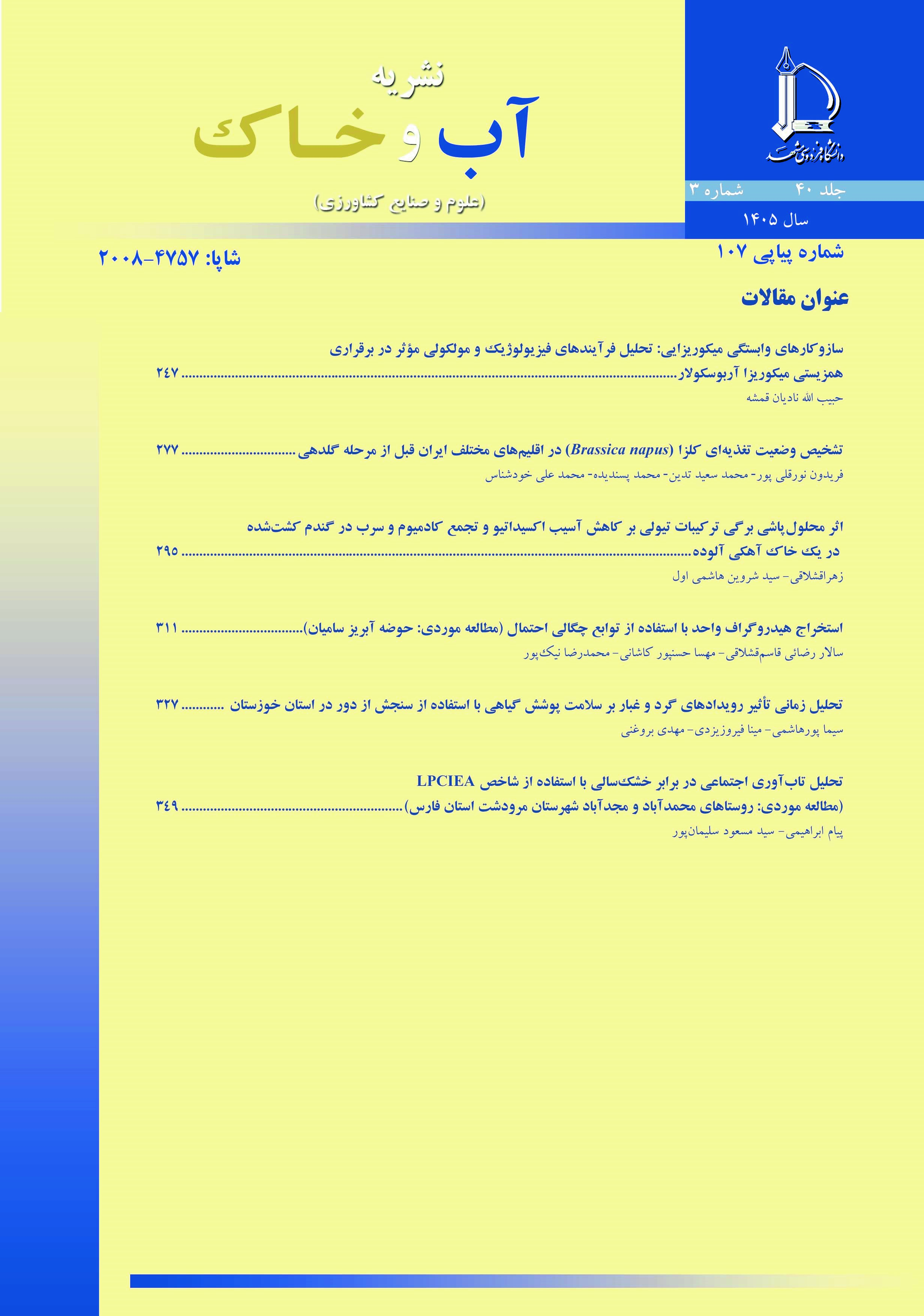
فصلنامه
نوع مقاله : مقاله پژوهشی
نویسندگان
1 واحد تحقیقات آبخیزداری مرکز تحقیقات و آموزش کشاورزی و منابع طبیعی استان همدان، سازمان تحقیقات آموزش و ترویج کشاورزی، همدان، ایران
2 بخش تحقیقات حفاظت خاک و آبخیزداری مرکز تحقیقات و آموزش کشاورزی و منابع طبیعی استان فارس، سازمان تحقیقات آموزش و ترویج کشاورزی، شیراز، ایران
کلیدواژهها
عنوان مقاله English
نویسندگان English
Introduction
Drought can be considered one of the most significant hazards for sustainable living in rural areas of Iran, many regions of which are characterized by arid and semi-arid climates. During the last decades, drought occurrence has led to a decrease in the provision of ecosystem services and negative socio-economic consequences. Moreover, pressure on surface and underground water has been rising, especially in the agriculture-focused Fars Province. Despite numerous drought assessment studies performed in Iran, the use of composite indexes that would integrate both social and environmental aspects of drought resilience on the basis of objective and available data is relatively rare. Indeed, earlier studies had used narrow criteria sets or questionnaire-based approaches to estimate social resilience, without developing a replicable data-driven approach. However, such a development is needed due to the multi-dimensional nature of the concept, which encompasses several factors like land use dynamics, population trends, agricultural diversity, irrigation systems, education, and employment age structure. Therefore, development of a composite index to analyze all those factors is required for effective decision-making in this field. In this paper, the analysis of social resilience to drought on the basis of the LPCIEA composite index is conducted in two rural settlements – Mohammadabad and Majdabad – of Marvdasht County, Fars Province, over a 24-year period (2000-2024).
Materials and Methods
LPCIEA composite index includes six criteria: Land use (L), Population (P), Crop diversity (C), Irrigation level (I), Education (E), and Employment age (A). Data on these criteria were collected from various sources: Landsat ETM (2000) and Sentinel-2 (2024) imagery for land use classification and Normalized difference vegetation index (NDVI) calculation; census statistics and village level data for population and education; and field survey for irrigation level and crop diversity. Image pre-processing, including atmospheric and geometric correction, was carried out in Environment for Visualizing Images (ENVI) 5.6, while maps of land uses were created on the basis of Support Vector Machines (SVM) classification with accuracy from 86% to 91% and Kappa index from 0.82 to 0.89. Crop diversity was estimated on the basis of Shannon-Wiener index. All variables were standardized using the Min-Max method to 0-1 scale. Weights for each criterion and sub-indicator were objective and estimated by means of Principal Component Analysis (PCA), which accounted for 76.4% of total variance using five principal components. Resilience score (R) for each village was calculated as a linear weighted combination of six standardized criteria. Multiple regression analysis (ENTER method) was used to determine contributions of each criterion to total resilience. Model validation was carried out using Durbin-Watson statistic and tests for multicollinearity (VIF and Tolerance), while spatial maps of resilience were generated for 2000 and 2024.
Results and Discussion
Over the period of 24 years, 12 states of resilience were identified for the two villages and six criteria. Six of them were red ("very low resilience"), three were yellow ("moderate but declining") and only three states were green ("favorable"), which indicates the dominance of critical states and a long-term erosive trend. The regression model had excellent goodness-of-fit, with multiple correlation coefficient (R) of 0.995 and adjusted R² 0.98, while Durbin-Watson statistic of 1.892 indicates the absence of autocorrelation. Out of six criteria, "Crop diversity" (C) had the greatest positive and statistically significant effect on resilience with the beta coefficient of 0.785 (p < 0.01), contributing to 96% of explained variance. On the contrary, "Education" (E) had the lowest effect (β = 0.095, p = 0.63), which indicates that despite the considerable increase in literacy rates, it had little influence on drought resilience in compared with agricultural diversification and irrigation. Other criteria in order of importance were Population (β = 0.465), Employment age (β = 0.430), Land use (β = 0.380), and Irrigation (β = 0.250). The derived regression equation is as follows: R = 1.450 + 0.090L + 0.220P + 0.185C + 0.110I + 0.040E + 0.145A. According to temporal analysis, Majdabad village showed considerable population growth (resilience score from 46 to 77), Mohammadabad village showed moderate growth (44 to 50), while both villages suffered from a severe decrease in crop diversity (from 42 to 7 points) and irrigation level (from 36 to 16 points), which is a consequence of water shortage. On the other hand, the education score increased substantially (from 8 to 41-46 points), but did not lead to the corresponding increase in resilience because of the priority of production-related factors.
Conclusion
It is evident that drought resilience in the analyzed villages is mostly determined by crop diversification and availability of water resources, rather than demographic and educational factors. Majdabad village, which has greater population (8,970 people) and greater pressure on resources, needs urgent adaptive measures, followed by Mohammadabad. The dominance of red-status resilience states (6 of 12) indicates critical a threshold, and immediate policy measures are needed. Therefore, the following recommendations can be made on the basis of this research. It is necessary to focus the supportive policies on increasing crop diversity, promotion of crops with low water demand and diversification of the agricultural portfolio. Equally important is active participation of local communities in decision-making bodies – like strategic planning, priority setting and budget allocation, which will promote social cohesiveness and joint actions. Different villages showed different adaptive capacities under similar climatic conditions, therefore, a differentiated rather than general strategy is needed. The index LPCIEA, which provides objective weighting based on PCA and uses replicable satellite and census data, is a useful instrument for periodic resilience monitoring. Future research should expand this approach to other regions and incorporate climate projection scenarios into it.
Acknowledgement
This work is derived from part of the results of an independent research subproject entitled "Analysis of Social Resilience to Drought Using a Composite Index (Case Study: Fars Province)", with code 0-66-29-012-010495 and approved by the Soil Conservation and Watershed Management Research Institute. The authors of this article would like to acknowledge the cooperation and support of that research institute and the support of the Fars Agricultural and Natural Resources Research and Education Center.
کلیدواژهها English
|
Authors retain the copyright. This is an open access article distributed under Creative Commons Attribution 4.0 International License (CC BY 4.0) |